

Haifa oil refineries will close in 2029, says head of Haifa Bay development agency
Yuval Admon, working within the Prime Minister’s Office, says 2026 crucial for shortening timelines, while KKL-JNF boss pledges NIS 100 million for new parkland
 Add ToI as a Preferred Source on Google
Sue Surkes is The Times of Israel's environment reporter
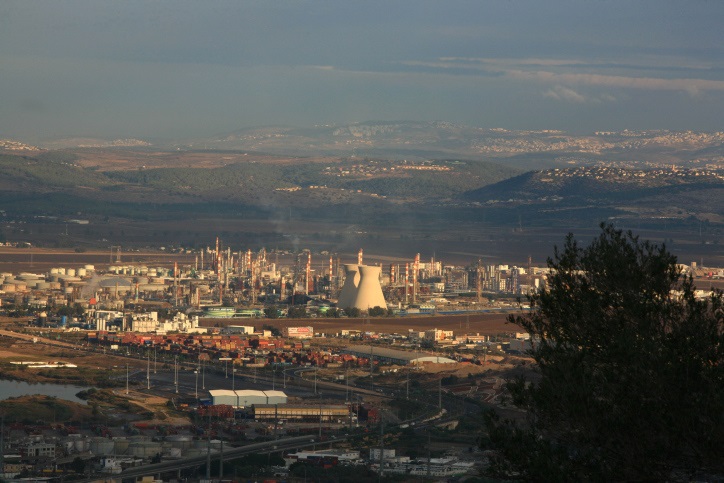
Haifa’s Bazan oil refineries—which environmentalists and residents of the north have campaigned to shut down for decades—will cease operations in 2029, the head of the state directorate charged with rehabilitating the Haifa Bay pledged on Tuesday.
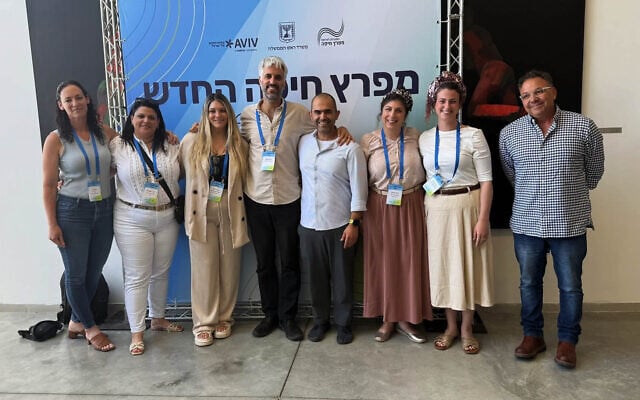
Yuval Admon concluded the annual conference of the Directorate for the Development of Haifa Bay, held at Haifa University, by saying that his team would be doing “very complex” work this year with the many government ministries and other state bodies involved, “to examine very seriously how we ensure that in 2029, the refineries close, and what stages will be needed for this to happen.”
In 2022, the cabinet voted to shut down the polluting refineries in the Haifa Bay and the oil storage complex in nearby Kiryat Haim.
The directorate, established soon afterward in the Prime Minister’s Office, set itself the goal of closing the complexes by 2029. However, its 2025 annual report, published in March, pushed this date back to 2031.
Admon now hopes solutions can be found to bring the closure forward again to 2029.
Budgets were not an issue, Admon told The Times of Israel, after the conference, adding, “governments just take time.”
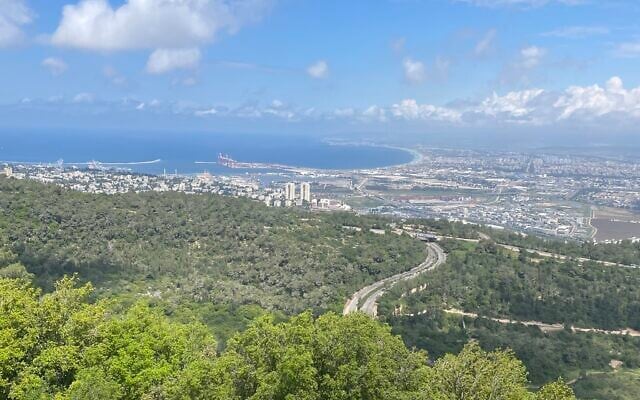
Closing the petrochemical industry and cleaning and releasing the land it occupies for development is critical to transforming the bay area into an urban hub that rivals Tel Aviv and serves as an economic driver for the whole of northern Israel.
Plans envisage 130,000 new homes, a new hospital, walkable streets and bicycle paths, beaches, parkland, canals and clean, green jobs.
But Bazan cannot be closed until alternative infrastructure has been built to import, transmit, store and distribute the materials that Bazan produces or handles today. These are distillates (gasoline, diesel and jet fuel), cooking gas (LPG), condensate (a crude oil byproduct of the fossil fuel gas industry) and bitumen.
Admon explained to The Times of Israel that two main bottlenecks were affecting the 2029 deadline. One related to storing 550,000 tons of distillates beneath the Carmel mountain range; the other to storing 20,000 tons of cooking gas near Kfar Masaryk in the western Galilee. Both sites are in northern Israel.
Planning for storing and distributing distillates, and the environmental surveys underway, were taking longer than predicted, Admon said. Once completed, the Israel Lands Authority will pass the surveys to the national planning authority, after which the public will be invited to submit objections, he explained.
The three locations currently being surveyed are near Kishon Prison, between Yokneam and Eliakim, and at Moshav Ein Ayala. The Hof HaCarmel Regional Council has already registered staunch opposition to the latter.
Admon said he thought existing storage sites could be used temporarily for distillates, enabling Bazan to close in 2029.
Regarding the cooking gas site, he said he expected the Finance Ministry’s Accountant General to issue an international tender in the coming months, following a pre-qualification document that helped screen out unsuitable bidders and revealed significant interest.
KKL-JNF seeks key role
The Haifa Bay project is the largest of its kind ever undertaken in Israel.
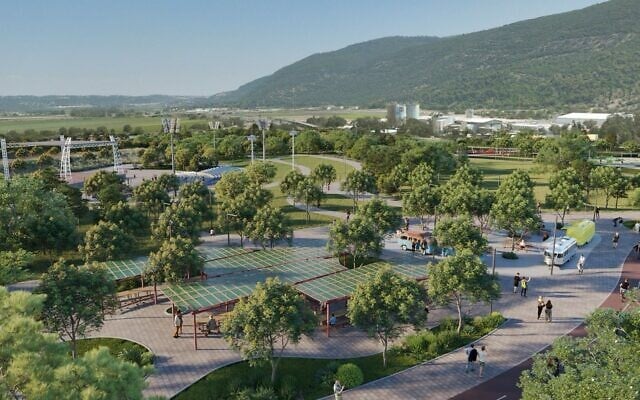
A central element will be the creation of a 6,000-dunam (1,482-acre) park, twice the size of Tel Aviv’s HaYarkon Park and nearly twice the size of New York’s Central Park.
Occupying the Kishon River’s floodplain, the park will run alongside the river itself.
Closest to the Mediterranean coast, the Kishon River Authority currently manages a 15-dunam (3.5-acre) park. Its CEO, Sharon Nissim, has completed plans to expand this into a 1,000-dunam (250-acre) green lung stretching from the sea to the corner of the Bazan refinery complex.
The big surprise of Tuesday’s confab was an announcement by Eyal Ostrinsky, the recently elected chairman of the KKL-JNF Jewish National Fund, that the KKL board had voted to plow NIS 100 million ($33.7 million) into Nissim’s project over three years — and that this was just the start.
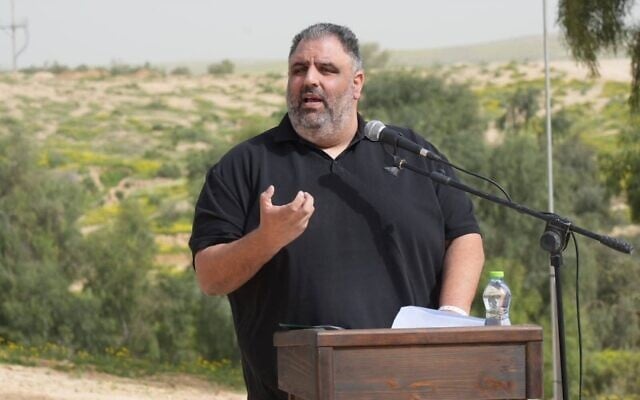
He revealed that KKL was in advanced talks with the Haifa Municipality to establish, manage and maintain the entire 6,000-dunam park, extending westward to the city of Nesher, where two former quarries are set to become the centerpiece of parkland.









The Times of Israel Community.