

Katz: Israel will facilitate emigration from Gaza ‘by any means’ as soon as Trump allows
Defense minister claims 80% of Palestinians want to leave Gaza, but nobody will take them; PM visits IDF post in Strip, says Israel won’t withdraw from territory it currently holds
 Add ToI as a Preferred Source on Google
Defense Minister Israel Katz said on Wednesday that plans to facilitate the mass emigration of Palestinians from Gaza remain under discussion and were merely “frozen” by US President Donald Trump, not taken off the table entirely.
He discussed the plans, saying Israel would facilitate emigration “by any means,” at a conference hosted by Israeli newspaper Yedioth Ahronoth, at the same time as Prime Minister Benjamin Netanyahu paid a visit to an IDF outpost inside the Gaza Strip and reaffirmed that Israel had no plans to withdraw.
Katz, in a recorded clip from the conference, claimed that some “80 percent [of Gazans] want to emigrate,” citing unspecified surveys Israel has conducted, but that the unwillingness of other countries to take them in is a roadblock to implementing this.
“There is no real solution for Gaza in the end without this migration,” Katz insisted. “Hamas isn’t allowing them [to leave], and there are no countries in the world taking them in. President Trump put the issue on the agenda. Now every country needs to take people in — and that’s the big issue.”
Should other countries be open to taking in Gazans, Katz said the Israeli government “is organized and prepared to get them out — by sea, by air, by every way possible.”
The US embassy referred requests for comment to the State Department in Washington.

Trump initially proposed relocating Gaza’s roughly 2.3 million residents in February 2025, prompting Israel to establish a Defense Ministry directorate tasked with facilitating what officials termed “voluntary emigration.”
Trump spoke of developing the coastal territory, devastated by the two-year war between Israel and Hamas following the Palestinian terror group’s October 7, 2023, onslaught, into a luxury resort destination.
The possibility sparked strong pushback, including from Egypt, and was condemned by Palestinians themselves.
Trump later abandoned the proposal amid international opposition and a lack of countries willing to receive Gazans, and in his October 2025 Gaza peace plan he appeared to walk away from it entirely, pledging instead to “encourage people to stay and offer them the opportunity to build a better Gaza.”
In June, Israeli security officials were reported to be seeking to revive the moribund plan and to have rebranded it in an effort to soften international opposition.
According to Katz, however, Trump did not abandon the plan, but has merely “frozen it” due to pressure from Arab states.
“The plan hasn’t been canceled; it is being discussed all the time, even now, and I think there is no other solution for everyone’s good,” the defense minister said.
Asked when he thinks the plan could be enacted, Katz did not give a direct answer, saying instead that it would be “when it becomes clear that Hamas is not fulfilling its commitment[s]” under the US plan for the Strip.
“Then we will get a green light to advance militarily, territorially, and in other areas as well,” he said.
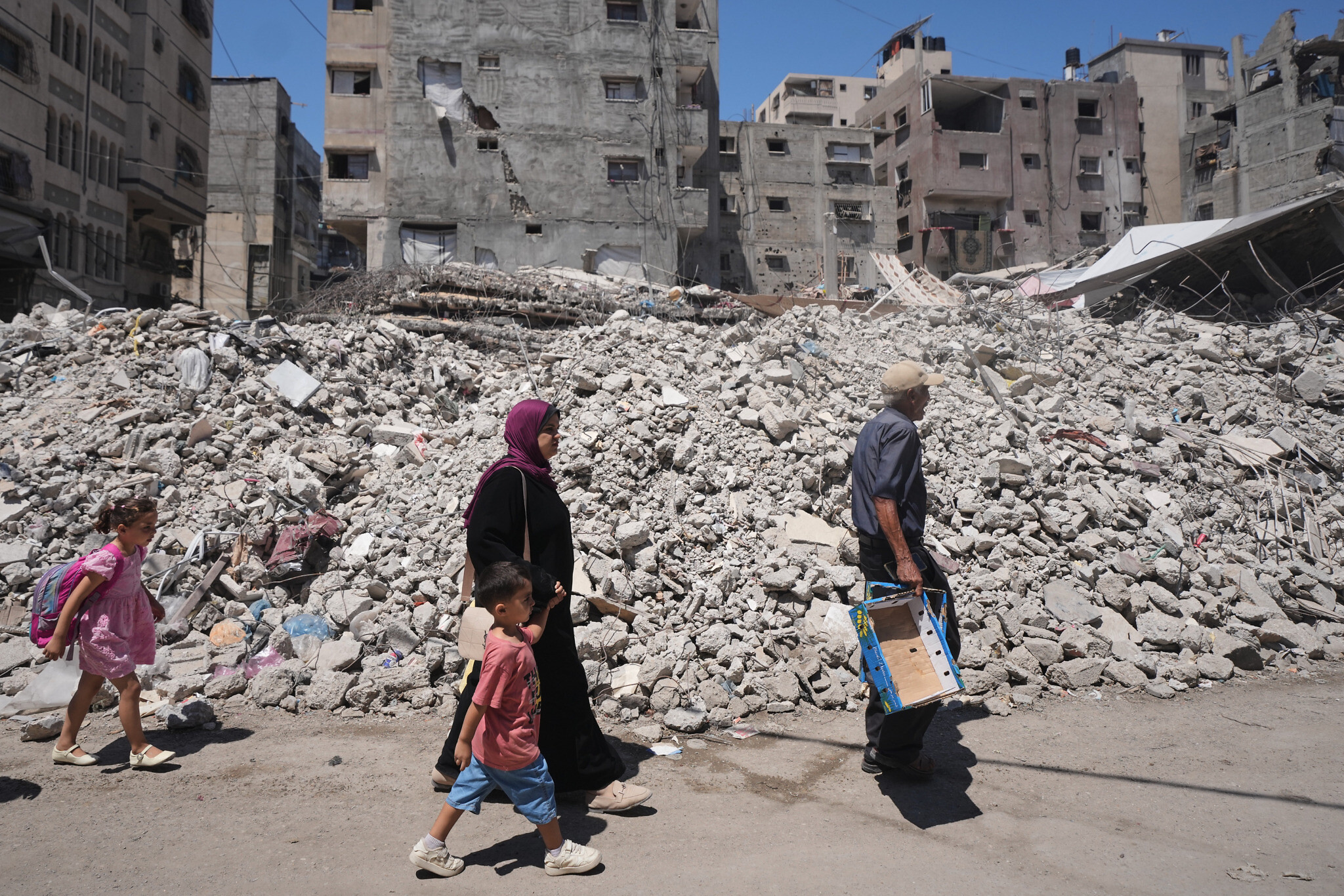
The war has already internally displaced the vast majority of Gaza’s people following the October 7 Hamas attack, in which some 1,200 people were killed in Israel and 251 were taken hostage.
Israel’s subsequent offensive has killed over 73,400 people in Gaza, including more than 1,330 since the October 2025 ceasefire, according to the Hamas-run health ministry in the enclave, although the toll does not differentiate between combatants and civilians.
The Israel Defense Forces believes that Hamas’s overall toll is largely accurate, with IDF officials estimating that two to three civilians were killed for every dead terror operative.
While the October 2025 US-backed ceasefire halted major fighting in the shattered territory, it hasn’t ended strikes by the IDF, which it says aims to thwart attacks by Hamas and other Gaza terrorists, and Gaza remains bisected into Israeli- and Hamas-controlled areas.
‘We are not withdrawing’
Netanyahu, on Wednesday, insisted that Israel had no plans to withdraw from the portion of the Strip that it currently holds, as he visited an IDF post close to the Yellow Line, the demarcation line that divides the enclave.
“We control the territory here,” Netanyahu said in a Hebrew-language video message sent by his office. He noted that the Israeli border towns of Ashkelon, Sderot, Netivot and several kibbutzim can be seen “in every direction” from the post.
“We are not withdrawing. We are staying on this line. We control 60% of the Strip. And there is still more to come, because we are eliminating the terrorists who threaten us — we do this day in and day out,” he said.

The premier has previously stated that Israel controls 60% of the Gaza Strip and had ordered the army to expand control to 70%, well beyond the portion of the enclave that Israel was allowed to continue holding as part of the ceasefire deal.
The conditions for Israeli withdrawal, and continued Israeli strikes, have become major sticking points in the US-backed Board of Peace’s talks with Hamas and Israel. While the terror group has agreed to a framework for gradual disarmament alongside phased Israeli withdrawals, Netanyahu has insisted on troops remaining in place until total disarmament is verified.
“We are doing everything necessary to achieve our objective — disarming Hamas and demilitarizing Gaza, [and ensuring] Gaza will no longer pose a threat to Israel,” Netanyahu said in the recorded remarks, adding that “to a large extent, this objective has in fact already been achieved. There is still work to be completed — and we will complete it.”
Netanyahu was accompanied on his visit by IDF Chief of Staff Eyal Zamir, Southern Command chief Yaniv Asor, and commander of the 99th Division Elad Tzuri.
The Prime Minister’s Office said he was briefed by commanders on the ground regarding IDF operations in the area “to eliminate threats and safeguard the security of the troops and Israeli communities,” and attended a security assessment with senior officials at the Gaza Division headquarters.
It was the first time Netanyahu has visited the Strip since the ceasefire came into effect in October 2025, and it took place the day after an Israeli operation in the enclave to capture the commander of Hamas’s internal security apparatus.
At least four people, including two children, were said by medics to have been killed in the heavy bombardment that accompanied the operation.
On Wednesday, Hamas-controlled media outlets reported that one person was killed and several others were wounded in a drone strike in the al-Mawasi area of Khan Younis in the southern Gaza Strip.
Meanwhile, the IDF announced on Wednesday that two Hamas operatives, including a commander in the terror group’s “military security department,” were killed in a strike in the Gaza Strip on Monday.
The strike killed Talal Mustafa Saleh Badawi, a commander in the military security department in Hamas’s Gaza City Brigade, and Momen Saeed Mohammed Al-Hawari, another Hamas operative, according to the IDF.
The IDF said both operatives had been advancing attacks on troops and civilians, as well as trying to restore Hamas capabilities, “in systematic violation of the ceasefire.”
The military also said that combat engineers recently demolished a kilometer-long, or 0.6-mile, tunnel in northern Gaza.
The IDF said that since the October 2025 ceasefire, the brigade and combat engineers of the Yahalom unit have demolished over 26 kilometers (16 miles) of tunnels on the Israeli side of the Gaza ceasefire line.
Agencies contributed to this report.










The Times of Israel Community.