

Live updates
 Add ToI as a Preferred Source on Google



Key updates, 28 November 2026:
Ukraine says laser downs Russian drone for first time
Ukraine has for the first time used a laser weapon to shoot down a Russian jet-powered drone, its state-backed defense group Brave1 tells AFP.
Earlier this week, Serhiy Beskrestnov, an adviser to Ukrainian President Volodymyr Zelensky, published footage showing a target crashing in a fireball, saying a Russian Geran jet drone had been shot down by a laser system for the “first time.”
“Footage recently emerged online showing a Ukrainian laser system being used in combat to intercept an enemy jet-powered drone,” Brave1 says.
The weapon was developed by a recipient of a Brave1 grant and operated by a private air defense team, it adds.
Ukrainian presidential adviser Serhiy "Flash" Beskrestnov:
A Russian jet-powered Shahed was downed by a Ukrainian laser air defense system. A first in history. pic.twitter.com/tJTZVjNOJo
— Open Source Intel (@Osint613) November 25, 2026
But Brave1 cautions that “a first successful interception does not mean the technology is ready for mass deployment.”
“Laser air defense remains an experimental technology,” it says, adding that at least seven teams in Ukraine were currently working on laser weapons.
Zelensky’s adviser Beskrestnov said the system, known as Blysk and developed by Carmine Sky, was protecting critical infrastructure during the interception.
Ukraine has faced near-daily barrages of Russian drones and missiles throughout the war.
In recent months, Moscow has increasingly deployed jet drones, which are faster and harder to bring down than earlier models.
According to Brave1, laser weapons have been in development since the 1970s but are operational in only a handful of countries. Successful combat shoot-downs of airborne targets with the technology are still rare.
Israel has also deployed one of its own Iron Beam laser air-defense systems, though it has seen limited use and has not been declared operational within the IDF. A senior officer said in May that its coverage was partial and that a wider, more complete laser-defense array would take time.
Times of Israel staff contributed to this report.
IDF says Gaza strike killed two terror operatives working for Doctors Without Borders
The Israeli military says it killed two terror operatives who were working as members of the Doctors Without Borders (MSF) aid group in an airstrike in Gaza City last night.
According to the IDF, the strike on Friday night killed Ahmed Sufyan Mohammed Ali Abu Hasira, a terror operative, and Muath Yousef Ali Subh, a commander of an artillery squad in Hamas’s military wing, who both worked as security guards for an MSF clinic.
“This is another example of the Hamas terror organization embedding itself within international organizations,” the military says.
The IDF says contrary to claims, it did not target a hospital and no damage was caused to medical infrastructure. Palestinian media had reported that the strike took place near Gaza City’s Shifa Hospital.
MSF says two of its watchmen were killed. Palestinian outlets named Muath Soboh as one of them. The IDF says he served in Hamas’s military apparatus.
A 2022 Al Jazeera photo shows someone with the same name in front of a poster that bears the Qassam (Hamas) emblem. Also, I… https://t.co/5H5UQK5EK5 pic.twitter.com/8csHYJDHbC
— Joe Truzman (@JoeTruzman) November 28, 2026
MSF says the organization is “devastated and outraged by the killing of two of our colleagues, both watchmen, in an Israeli strike on one of our Gaza clinics tonight.”
“This is a direct hit on MSF, bringing the total number of MSF colleagues killed in Gaza to 17. Our premises were clearly marked with MSF logos, and their location had been communicated to and was known by the Israeli military. We stand in solidarity with the families and loved ones of our colleagues. We call for accountability,” it says in a statement.
The medical organization has repeatedly denied that it employs members of terror groups despite overwhelming evidence to the contrary.
Both operatives had recently been advancing attacks on troops and Israeli civilians and acted to restore the capabilities of terror groups in Gaza, “in systematic violation of the ceasefire,” the military says, adding that they were killed to “remove the threat they posed.”
Two tankers hit by mines near Hormuz, IRGC says

A vessel transits the Gulf of Oman off the coast of Khor Fakkan in the emirate of Sharjah in the east of the UAE on October 13, 2026. (AFP)
Two oil tankers were hit by mines near the Strait of Hormuz, the Islamic Revolutionary Guard Corps Navy says, according to Iranian state media.
According to the IRGC, the tankers were traveling along “unauthorized routes” near the key waterway.
WHO chief meets Venezuelan president in first visit to country by head of UN health agency
World Health Organization (WHO) chief Tedros Adhanom Ghebreyesus meets with Venezuela’s interim president, Delcy Rodriguez, in the first official visit to the country by a head of the UN agency.
The WHO says it would support domestic pharmaceutical and vaccine production and efforts to strengthen the public health system, whose hospitals are in crisis due to shortages of medical supplies and deteriorating infrastructure.
“This is the first time a director general of the World Health Organization has visited Venezuela, and we are very happy to have him here,” Venezuelan Health Minister Carlos Alvarado says from the presidential palace.
Neither the WHO or Venezuelan officials give specific funding or investment amounts.
Ousted president Nicolas Maduro had strained relations for years with the WHO over disagreements regarding health data and his refusal to acknowledge any health crisis in the country.
The devastation caused by the earthquakes in #Venezuela goes far beyond destroyed buildings. They have further weakened an already strained health system.
Today, I visited one of the affected areas. Assessments of 26 health facilities across metropolitan Caracas reveal that only… pic.twitter.com/9zxgjh9kWX
— Tedros Adhanom Ghebreyesus (@DrTedros) November 27, 2026
After entry barred, UN rapporteur Francesca Albanese says she will leave Costa Rica today
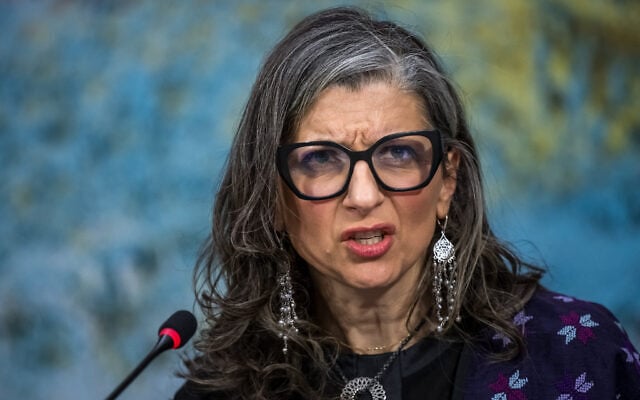
United Nations special rapporteur on the Palestinian territories Francesca Albanese presents her latest report before delegates at the UN Rights Council, in Geneva, on March 23, 2026. (Fabrice COFFRINI/AFP)
SAN JOSE, Costa Rica — Francesca Albanese, the UN special rapporteur on the Palestinian territories, who was denied entry into Costa Rica over links to terrorism, says she would leave the country today.
“Second night in the airport. Guarded by security at every step. Unconfortable (sic) chairs. Noise. Bright light. Counting the hours till my flight tomorrow,” she writes on X.
Times of Israel staff contributed to this report.
Saudis shoot down cruise missile targeting Riyadh
RIYADH, Saudi Arabia — Saudi Arabia says it shot down a cruise missile targeting the capital, Riyadh, after Houthi media reported Saudi strikes on Yemen.
“Air defences intercepted and destroyed a cruise missile launched by the Houthi terrorist militia towards the Riyadh region,” Saudi coalition spokesperson Turki Al-Malki writes on X.
It comes as Houthi news agency Saba reported a Saudi attack on Yemen’s capital Sanaa, which the fighters control.
“Eight homes and three shops were damaged after Saudi enemy forces targeted the residential neighborhood of Bir Abu Shamlah in Al-Tahrir district, Sanaa,” Saba posted on Telegram.
The attack wounded 13 people, according to Houthi news outlet Almasirah.
Report: US military repelled drones at UK airbase this month; Iran suspected of involvement
The US military repelled a half dozen drones swarming Britain’s RAF Lakenheath base earlier this month, the Financial Times reports, saying Iran is suspected of being linked to the incident.
The newspaper, citing people familiar with the matter, says the US deployed counter-drone technology to repel the unmanned aerial systems but that the drones were not retrieved by British or American personnel.
Asked for comment on the report, a spokesperson for the UK’s Ministry of Defence tells Reuters in an emailed statement: “Ministry of Defence Police and Suffolk Police worked closely with USAF Security Forces to respond to reports of unauthorized drone activity at RAF Lakenheath on 13 November and the situation was quickly resolved, with RAF Lakenheath returning to normal security and force protection measures.”
The White House and Pentagon do not immediately respond to requests for comment.
In the incident, US Air Force personnel at the base responded to “suspected unauthorized drone activity,” and an Air Force spokesperson said at the time that no personnel, aircraft or infrastructure were affected.
UN refugee agency seeks $7.1 billion in 2027

Women and children queue to receive free food being distributed in al-Mohayra camp for displaced people, near the city of El-Obeid in the southern Kordofan region, on June 29, 2026. (AFP)
The United Nations’ refugee agency says it is seeking a much-reduced $7.1 billion to protect stateless people and respond to emergencies in 2027.
UNHCR chief Barham Salih warned last month that his agency was being “asked to do the impossible,” over-stretched by a huge funding shortfall and near record-high population displacements around the world.
UNHCR’s 2026 appeal targeted $8.5 billion — of which only $2.9 billion has been raised to date.
“The appeal comes amid immense humanitarian needs and an exceptionally difficult funding environment. As a result, UNHCR’s 2027 budget prioritises the most urgent needs,” the agency says.
If fully funded, UNHCR would use the money next year to provide protection services for 13.6 million refugees and asylum seekers and 6.7 million internally displaced people (IDPs).
“We also aim to provide financial assistance to 3.9 million refugees and two million IDPs, and shelter and housing assistance for 1.8 million refugees and 850,000 IDPs,” the agency says.
Some 117.8 million people worldwide were forcibly displaced from their homes at the end of 2025, according to UNHCR — down slightly from 2024’s record 123.2 million.
Of those 117.8 million, 35.6 million were refugees under UNHCR’s mandate, with two-thirds coming from Afghanistan, Sudan, Syria, Ukraine and Venezuela.
Despite those elevated numbers, the agency has had to slash its workforce due to budget cuts.
Former Iran coordinator at UK Amnesty says rights organization fixated on Palestinian issues

File - Iranians protest the death of 22-year-old Mahsa Amini after she was detained by the morality police, in Tehran, October 1, 2022. (AP Photo/Middle East Images, File)
The former Iran country co-ordinator at UK Amnesty International says the rights organization became so focused on Palestinian matters that other issues fell by the wayside.
Sara Saei Joeghan, who arrived in the UK from Iran as a refugee in 2015, says she joined the organization because it was well-respected.
“I wanted to help people back at home; I didn’t want to just leave them behind. So one of the first things I did when I got off that plane was join Amnesty,” she tells the UK’s The Times. “In Iran, Amnesty International is very respected. It’s something people trust. They think it makes a difference. We don’t have a voice and we believe that Amnesty is bringing our voice to the world.”
However, she says that the organization began platforming individuals who were supporters of the Islamic Republic’s regime.
She says that a 2025 event to discuss the persecution of religious minorities in Iran was refocused to Palestinian issues.
“While both countries are in the same region, their issues are vastly different. It should be possible at Amnesty to talk about repression and other issues facing the Iranian people — there are many events and opportunities focused on Gaza,” she says. “By combining Iranian and Palestinian issues, the focus on the serious human rights abuses occurring in Iran is diluted. As an Iranian I strongly felt that our issues should be treated with the attention and respect they deserve.”
Joeghan points to the “No to Gaza” movement in Iran which campaigns against Tehran’s involvement and funding of terror groups.
“An Iran Amnesty country co-ordinator saying they are organizing an Iran event, but in fact using it to campaign for Palestine, only serves to distract from the real human rights abuses happening in Iran,” she says.
Joeghan also says Amnesty says a screening of a documentary on the 2022 shooting of Iranian protesters was nixed for being political.
“I was astounded,” Joegahn says, “given the political nature of the other events they were condoning. If it’s against Trump or Israel it’s OK, but they don’t like it when it’s against the Iranian regime.”
In response, Amnesty tells the newspaper that it is impartial, with an “unequivocal” commitment to human rights in Iran.
UK pulls license of Arabic channel LuaLua TV for ‘glorifying’ Oct. 7, Hamas and Hezbollah
British regulators have revoked the license of Arabic news channel LuaLua TV for broadcasting materials that “glorified” the October 7 terror onslaught and the actions of Hamas, Hezbollah and Palestinian Islamic Jihad.
The main complaint involves a speech given on October 7, 2026, by Houthi leader Abdul Malik al-Houthi, that was livestreamed by the outlet.
Ofcom says a number of social media posts on the channel’s accounts showed support for terror groups and their leaders.
According to the Ofcom regulator, LuaLua TV is an Arabic news channel “focused primarily on Bahraini audiences and currently available in the UK as a livestream via its website.”
It is unclear how many people in the UK watched the channel.
According to the UK’s Jewish News, the outlet is funded by the anti-monarchy Bahraini opposition in London.
Explosion reported at school in Afghanistan, official says
An explosion has occurred at a school in Afghanistan’s northeastern province of Kunar, an official says.
Sami-ul-Haq Haq Bayan, the province’s director of information and culture, says he cannot provide details on the nature of the explosion in Asadabad in Kunar or whether there were casualties.
Armed group seized cargo ship off Yemen’s coast, maritime agency says
Armed individuals boarded a cargo ship 64 nautical miles southwest of Yemen’s Balhaf at 0630 GMT and took control of the vessel, the United Kingdom Maritime Trade Operations agency says, citing the ship’s master.
UKMTO says authorities have been informed and advises vessels in the area to proceed with caution.
Large shipment of weapons, drugs attached to balloons seized on Egypt border — IDF
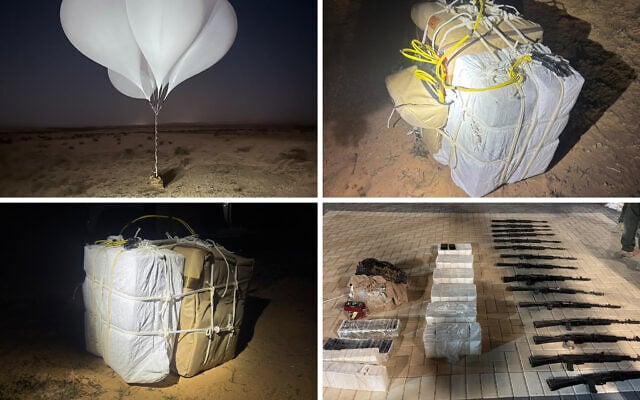
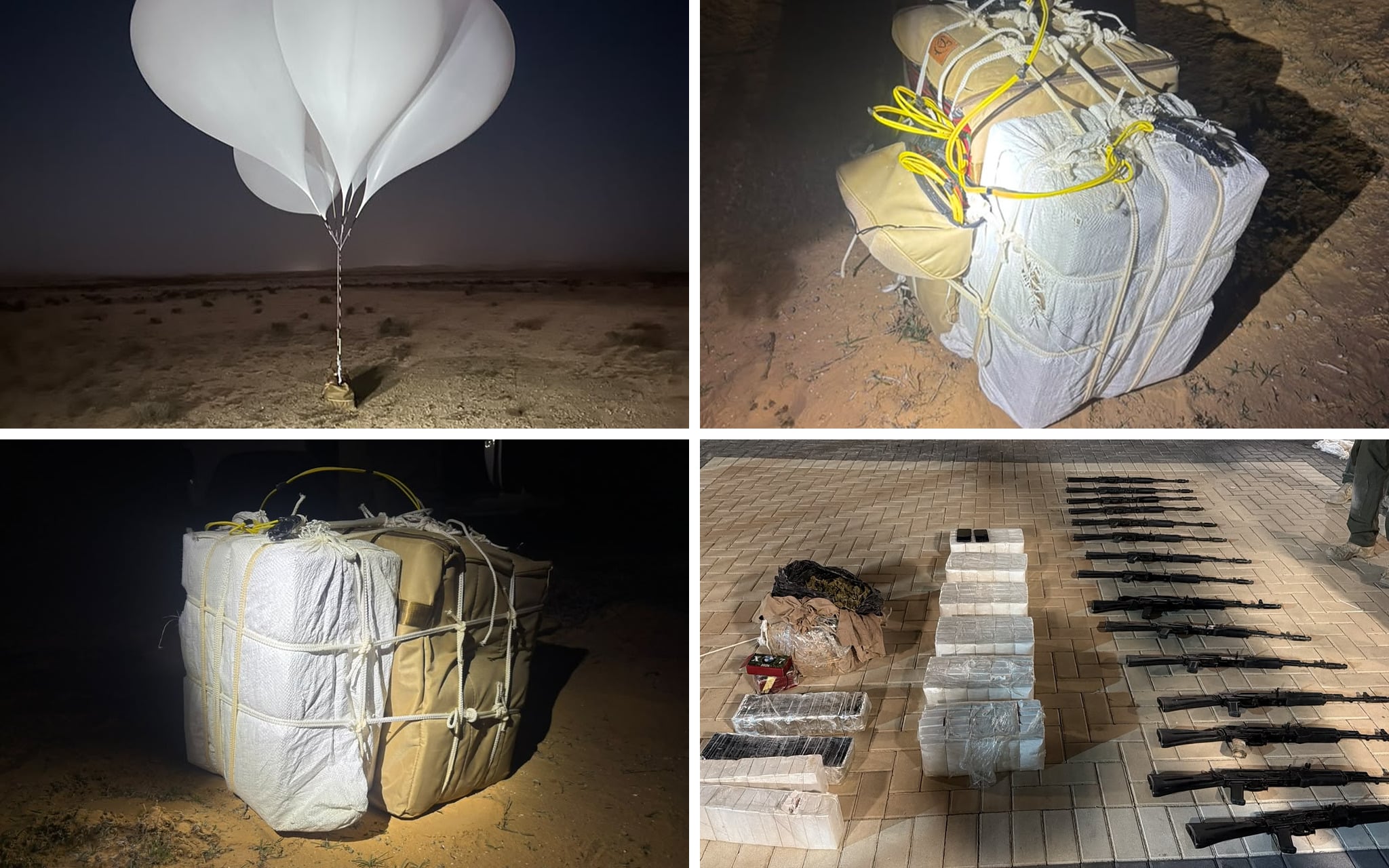
A shipment of drugs and weapons captured by IDF troops following a smuggling attempt on November 28, 2026. (Israel Defense Forces)
Israeli security forces captured a large shipment of weapons and drugs that was smuggled over the Egyptian border into Israel using balloons.
The military says troops spotted a bunch of balloons floating over the border from Egypt into Israel overnight.
Soldiers of the 80th “Edom” Regional Division and police officers were dispatched to the scene and located the balloons.
The army says the balloon was found to be carrying 15 Kalashnikov rifles, two cellphones, and three packages containing over 100 kilograms of an unnamed drug.
Police took the contraband for further investigation.
There have been frequent attempts to bring weapons, and sometimes drugs, over the Egyptian and Jordanian borders using drones in recent years. In recent months, such attempts using balloons have increased.
Houthis report airstrikes in Yemen’s Sanaa, Red Sea port city Mokha
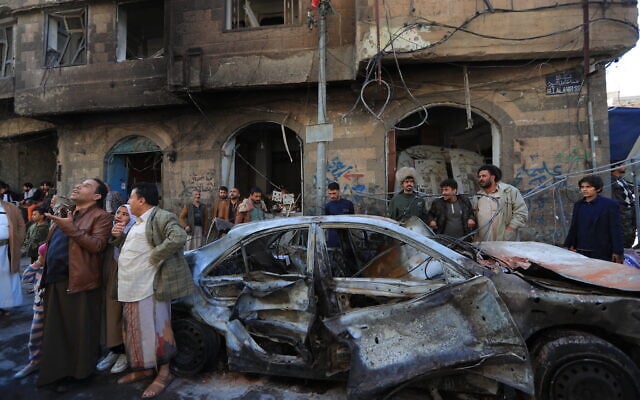
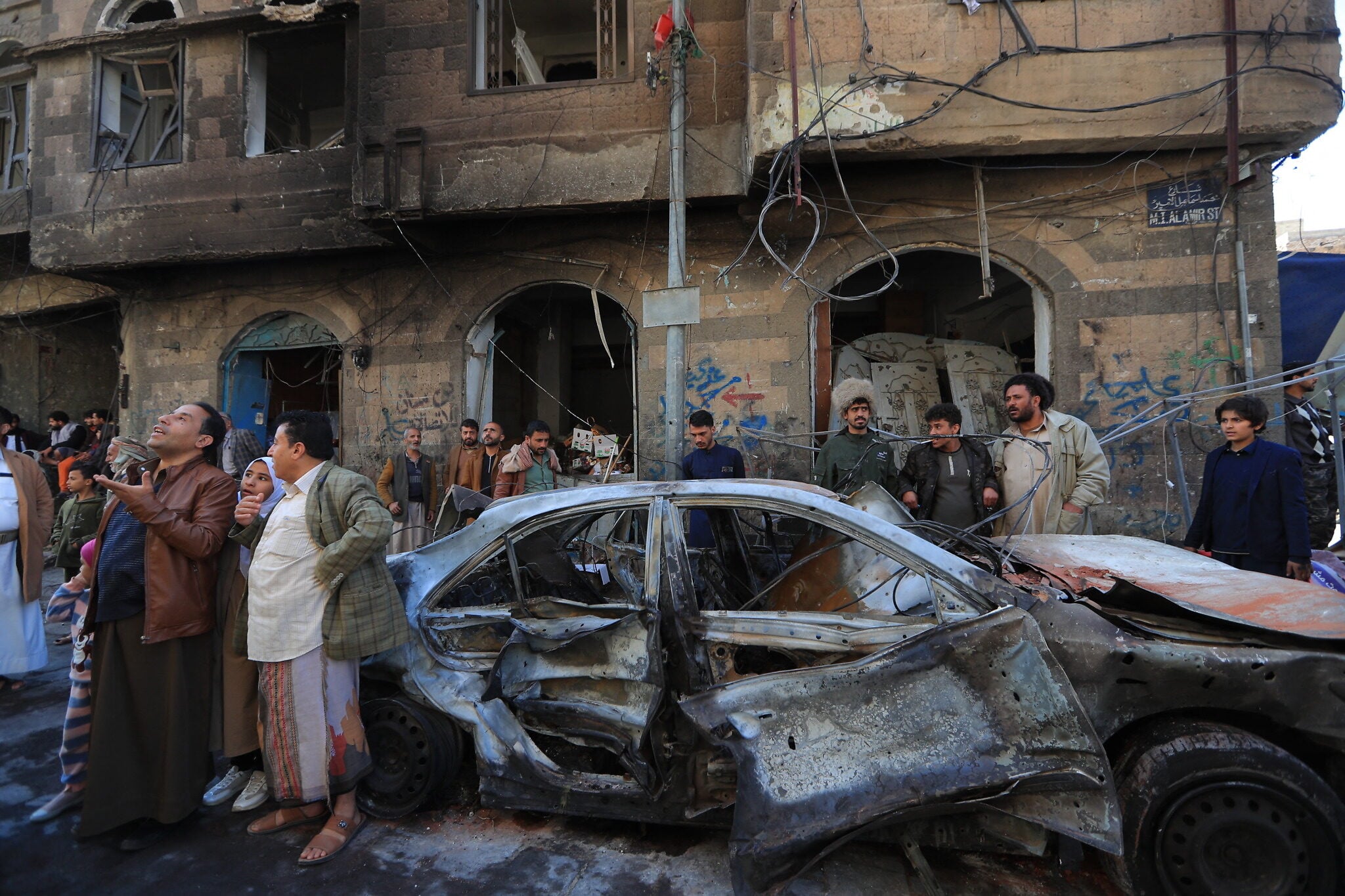
Yemenis inspect damage to a residential neighbourhood following a drone strike attributed to the Saudi-led coalition in Sanaa on November 28, 2026. (MOHAMMED HUWAIS/AFP)
Houthi-run Health Ministry spokesman Anees al-Asbahi says two women were among at least 15 people wounded in a strike in the Abu Shamla neighborhood in the capital Sanaa.
Al-Massirah satellite television reports damage to at least eight houses and three shops, while a gas station was also hit.
Al-Massirah also reports that strikes ignited a fire at a power plant in Mokha.
The Houthis blame Saudi Arabia for the strikes.
Saudi Arabia says air defenses intercepted, destroyed Houthi cruise missile targeting Riyadh
Saudi military spokesman Maj. Gen. Turki al-Malki says air defense systems intercepted and destroyed a Houthi cruise missile targeting the Saudi Arabian capital, Riyadh.
This came after the Saudi-led coalition fighting the Houthis said it launched an air operation yesterday against the rebels in Sanaa and the provinces of Hodeida on the Red Sea and Saada on the border with Saudi Arabia.
Masked settlers wound 3 Arab Israeli electric workers in central West Bank attack

Israeli settlers attack electrical workers near the West Bank town of al-Mughayyir, November 28, 2026. (Screenshot: X; used in accordance with Clause 27a of the Copyright Law)
Masked Jewish assailants attacked Arab Israeli workers from an East Jerusalem electric company who were carrying out maintenance work in the Ramallah-area village of al-Mughayyir, in the central West Bank, according to the Israel Police and Palestinian media.
Footage from the attack shows multiple assailants wearing black masks and hoodies wielding metal rods.
The windshield of a truck the workers used is smashed.
Three workers were wounded, according to police. Officers accompanied by the IDF are gathering evidence and testimony on the scene, police say.
The Jerusalem District Electric Company, an East Jerusalem firm that also services West Bank localities, confirms to The Times of Israel that the workers who were attacked are its employees.
The company had said on Facebook on Thursday that it would carry out work in al-Mughayyir today.
Haaretz reports the works were coordinated days ahead of time with Israeli authorities, but that the Israel Defense Forces failed to secure the area, which sees settler attacks on a regular basis.
JDECO is a private company based in East Jerusalem that purchases electricity from Israel to supply East Jerusalem and localities in the West Bank.
תראו האירוע המטורף הזה של מחבלים יהודים ליד הכפר אל מועייר סמוך לרמאללה:
רעולי פנים מגיעים על טנדר עם מוטות ברזל ואלות ומכים עובדים של חברת חשמל הפלסט' שהגיעו *בתיאום מראש* עם צה"ל לעבודות תשתית.
3 פצועים, אחד קשה.
וזה אירוע שפיקוד מרכז הכיר – ולא נערך.
עוד מחדל של אבי בלוט. pic.twitter.com/zAG7oJ9N6H— Josh Breiner (@JoshBreiner) November 28, 2026
Israeli and Turkish soccer fans clash at Batumi airport, days after game between sides halted
Israeli and Turkish soccer fans clashed in an airport in Georgia after they were stranded due to inclement weather, Hebrew-language media reports.
It is unclear how the violence broke out, but the two sides were separated by Georgian police, reports say.
The incident came after the Thursday game between Israel’s Hapoel Beersheba and Turkey’s Besiktas was suspended after clashes in the stands between Turkish supporters and security staff.
The game was played in Batumi, Georgia, since Turkey has refused to host Israeli teams.
Reports indicated that Georgian police officers attempted to stop Besiktas fans from unfurling a Palestinian flag in the stands, sparking the clash.
According to Hebrew media reports, the several hundred Israeli fans in attendance were completely separate from the Turkish fans under heavy security and were not involved in the clashes.
עימות התפתח בשדה התעופה בבטומי בין אוהדי הפועל באר שבע לאוהדי בשיקטאש הטורקית. המשטרה הגיאורגית חצצה בין הצדדים@lianwildau pic.twitter.com/AQpHeY6OLb
— כאן חדשות (@kann_news) November 28, 2026
International court rejects Argentina’s bid to block British-Israeli oil drilling project off Falkland Islands
A UN-backed international court rejects a bid by Argentina to temporarily block a British-Israeli oil project off the disputed Falkland Islands.
The case was the latest spat between Britain and Argentina, which fought a bitter 10-week war in 1982 over the UK-administered islands in the South Atlantic.
In September, Argentina launched an arbitration process against London over the Sea Lion project off the Falklands, led by Britain’s Rockhopper and Israel’s Navitas.
Ahead of any decision, it also called on the International Tribunal for the Law of the Sea (ITLOS) to impose emergency measures to suspend the project.
The Hamburg-based ITLOS, an independent court set up under UN auspices, rejects Argentina’s claims by 18 votes to three.
In a decision read out by ITLOS president Maurice Kamga, the judges rule there does not appear to be any basis for believing Argentina has jurisdiction, as the tribunal is unable to make decisions based on questions of sovereignty.
Buenos Aires had argued the plan violates a UN resolution calling for both sides to desist from unilateral actions until their dispute over the sovereignty of the islands is resolved.
It had asked the court to impose emergency measures and order Britain to take the necessary steps “to ensure that no new drilling for exploitation, and no installation of production infrastructure” takes place in the North Malvinas Basin.
It further urged the court to order the UK to “refrain from using the information obtained in the exploration of the natural resources of the disputed maritime areas.”
Key Update
IDF condemns ‘indiscriminate violence’ after settler attack on electric company workers
Israeli settlers attack electrical workers near the West Bank town of al-Mughayyir, November 28, 2026. (Screenshot: X; used in accordance with Clause 27a of the Copyright Law)
The military condemns the “indiscriminate violence” after masked settlers attacked Israeli Arab electrical company workers near the West Bank village of al-Mughayyir, injuring three of them.
The Haaretz daily reported that the work was coordinated days ahead of time with Israeli authorities, but that the Israel Defense Forces failed to secure the area.
According to the military, following an assessment “and analysis of potential friction,” several Border Police teams had been deployed nearby to prevent “criminal, violent and terror-related incidents.”
However, no force was stationed adjacent to the location of the electrical work to identify the incident in real time, according to the army.
“The work had been coordinated with only some of the relevant authorities,” the army says, adding that “as it involved work by Israelis, no demand was made for a close security escort,” and instead only “area-wide security was provided.”
No further details are given to clarify the military’s meaning when it says the work was coordinated with “some” authorities, and whether the lack of demand refers to the electric company, or from within the IDF.
The IDF says troops immediately rushed to the scene following reports of the attack, but the suspects had already fled the scene.
Chief of the IDF Central Command, Maj. Gen. Avi Bluth, held an assessment with senior military, police and Shin Bet officers on the incident, the military says.
“Security forces will act swiftly and decisively to locate and arrest the suspects,” the military says.
The IDF says that it “strongly condemns the incident and views any manifestation of violence with great severity,” calling it a “deliberate attack and indiscriminate violence against innocent people.”
Key Update
Britain welcomes court’s decision to reject bid to block UK-Israeli drilling project off Falkland Islands

Sunlight breaks through the clouds over Stanley on the Falkland Islands, March 14, 2026. (AP Photo/Ricardo Mazalan)
In a joint statement, British Foreign Secretary Ed Miliband and Attorney General Ellie Reeves welcome the decision by an international tribunal to reject Argentina’s bid to temporarily block oil drilling off the nearby UK-held Falkland Islands.
Miliband and Reeves urge Argentina to respect the right of the Falkland Islanders, who number around 3,500 people, to “determine their own future” and end its wider economic pressure.
“This outcome is a vindication of the UK’s robust legal defence and strategy,” they say. “The UK has no doubt of our sovereignty of the Falkland Islands, our sovereignty and sovereign rights over the surrounding maritime areas, and the right of self-determination of the Falkland Islanders.”
Argentine President Javier Milei has vowed to penalize companies working on oil production around the islands and argued that the joint UK-Israeli operation is a “clear and present danger” to his country’s claims over the islands.
Following the ruling, Rockhopper Exploration and Navitas Petroleum are expected to push ahead with the plan under licenses granted by the Falkland Islands government and backed by Britain.
Adviser to Iran’s supreme leader warns Iraq not to become ‘tool of Trump’
Mohammad Mokhber, an adviser to Iran’s Supreme Leader Ayatollah Mojtaba Khamenei, warns Iraq in a post on X not to become a “tool of Trump” after media reports that Iraq had closed several crossings following US efforts to blockade Iran’s land borders.
Gunmen shoot dead Sunni cleric in Iran’s southeast
Gunmen shot dead a Sunni cleric in Iran’s restive southeastern province of Sistan-Baluchistan, local media reports.
“Bashir Salahzehi, a well-regarded Sunni cleric in Sarbaz county… was assassinated hours ago in a terrorist act,” Iran’s Tasnim news agency says.
It is not immediately clear who was behind the attack.
Tasnim says the killing had been carried out by “mercenaries of the United States and the Zionist regime,” a phrase Iranian authorities often use to describe armed groups they accuse of acting on behalf of America and Israel.
Sistan-Baluchistan, one of Iran’s poorest provinces, has long been the scene of clashes between security forces and armed groups including separatist factions.
The province, which borders Afghanistan and Pakistan, has recently seen a resurgence in such unrest.
It is home to a large Baluch population, most of whom are Sunni Muslims in predominantly Shia Iran.
Earlier this month, a police officer was killed in Sistan-Baluchistan by unidentified assailants.
UAE ship hijacked off Yemeni coast was taken by Somali pirates, officials say
Pirates from Somalia hijacked a UAE-based ship off Yemen’s coast after disguising themselves as fishermen and hiding among the Somali community in Yemen, security officials say.
Piracy has seen a resurgence in the waters off the Horn of Africa, with at least 16 attacks since April, the highest level since 2013.
British maritime agency UKMTO said a cargo ship had been boarded by assailants some 120 kilometers (70 miles) southwest of Yemen’s Balhaf.
Three security officials in the Somali state of Puntland — home to the main network of pirates — say that it was the MV Marsa Virgo, a ship owned by Marsa Ocean Shipping, based in the United Arab Emirates, and operating under the Panama flag.
It was hijacked by six Somali gunmen who left Puntland in a fishing boat and made their way across the Gulf of Aden to Yemen, according to the security officials who tracked their movements through sources in the Somali community.
The security officials say there were 19 crew members onboard the MV Marsa Virgo, and that all had locked themselves in a safe room.
Their account could not be independently confirmed.
Saudi-led coalition says it intercepted Houthi ballistic missile fired at coastal town home to key sites
The Saudi-led coalition fighting Yemen’s Houthis says it intercepted and destroyed a ballistic missile fired by the Iran-aligned group toward the Saudi town of Al Shuqaiq, adding that the debris came down without causing any civilian casualties.
Al Shuqaiq, on Saudi Arabia’s Red Sea coast in Jazan province, is home to major desalination and power generation facilities supplying water and electricity to the kingdom’s southern regions.
IDF says electric workers attacked by settlers included Palestinians and Israelis

The aftermath of a settler attack on electricity company workers in the West Bank on November 28, 2026 (Courtesy)
The Israeli military says that, contrary to its earlier report, the victims of the settler attack on electrical workers near the West Bank village of al-Mughayyir included both Israelis and Palestinians.
Security sources have said the Israeli victims of the attack were Arab.
“The Central Command and the Civil Administration received an update indicating that the injured individuals include two Israeli civilians and two Palestinians,” the military says.
The army says the four were in vehicles with Israeli license plates.
“As previously stated, the incident is under investigation,” the military adds.
Police said earlier today that three people were injured in the attack — it is unclear why the military says that there were four victims.
Palestinian technocrats ink deal for Japan to assist in Gaza recovery; funding not disclosed
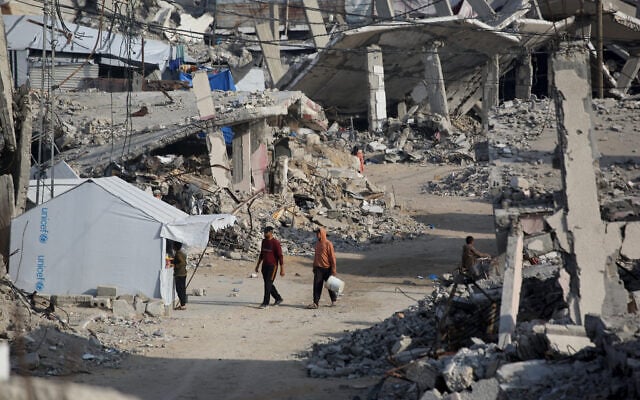
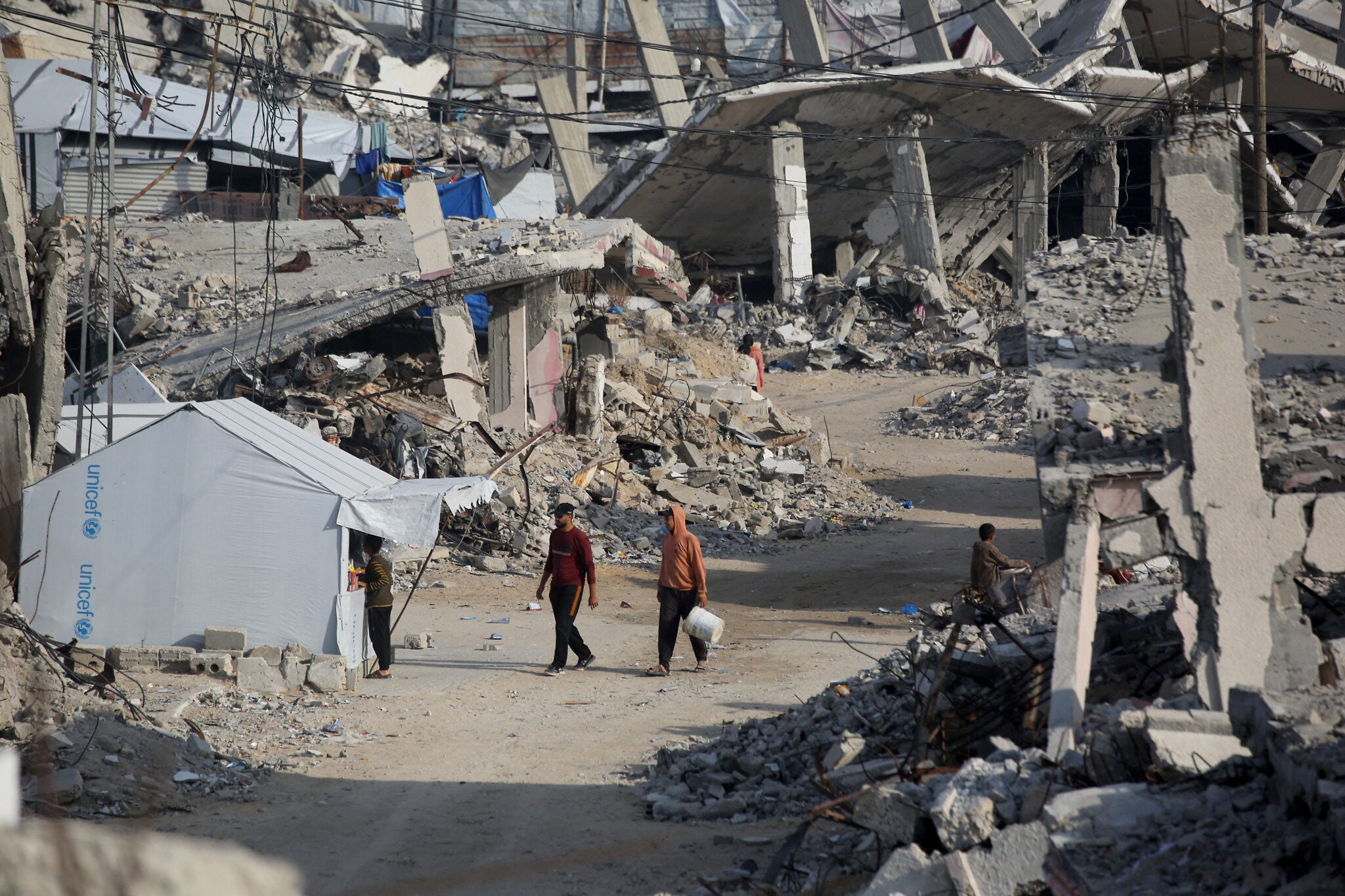
Palestinians walks past the rubble of homes and shops destroyed by the Israeli army during the Gaza war, in Jabalia in the northern Gaza Strip on November 28, 2026. (Bashar Taleb/AFP)
The Palestinian technocratic committee tasked with replacing Hamas in Gaza has signed a memorandum of understanding with the Japanese foreign ministry for the latter to assist in Gaza humanitarian projects.
The MoU “establishes a framework for structured consultations and coordination to advance early recovery, the restoration of essential public services, and the reconstruction of Gaza,” reads a statement from the National Committee for the Administration of Gaza (NCAG).
The statement by the NCAG, which is overseen by the US-controlled Board of Peace, does not reveal how much money Japan has agreed to donate to Gaza.
The board had dispatched a top delegation from the NCAG to visit Japan as it seeks new sources of funding. Less than two percent of the $17 billion in pledges made to the panel have been fulfilled. The board is still seeking $2.45 billion in funding for its first six months of recovery projects.
Joint Press Release
National Committee for the Administration of Gaza and the Office of the High Representative for Gaza
Japan, OHR and NCAG Sign Memorandum of Cooperation on Gaza’s Recovery and ReconstructionTokyo – 28 November 2026
Japan’s Ministry of Foreign Affairs, the… pic.twitter.com/Xg6qJ4yebs
— اللجنة الوطنية لإدارة غزة – NCAG (@NCAG) November 28, 2026
Key Update
Settlers attack Palestinians in at least three West Bank villages, reports say

Armed settlers seen at at-Tuwani on November 28, 2026 (Screenshots/Breaking the Silence)
Palestinian media reports several more attacks by Israeli settlers in the West Bank today.
In one incident in the southern village of at-Tuwani, Israeli settlers reportedly shot a man and assaulted his mother.
The man’s condition is not given, and further details surrounding the incident are unclear.
A typical Shabbat outing for three settlers from Maon Farm: invade Tuwani with state-issued assault rifles, gleefully harass and intimidate residents, open fire and wound a local knowing they are in full view of the cameras, then stroll off without a care in the world. pic.twitter.com/ETH0Qpan0l
— jasper nathaniel (@infinite_jaz) November 28, 2026
Elsewhere, Palestinian media cites the Red Crescent as saying that four Palestinians were wounded after being attacked by settlers at the al-Malih hamlet near Bethlehem.
In another incident, two Palestinians were wounded while clashing with settlers who attacked the village of Deir Jarir, near Ramallah, the reports say.
There is no immediate comment from Israeli authorities on the incidents.
Key Update
Condemning latest settler attacks, Eisenkot vows to put an end to ‘anarchy’ in the West Bank
Yashar chair Gadi Eisenkot condemns the multiple attacks by Israeli settlers in the West Bank today, after Arab electricity workers — both Palestinian and Israeli — were attacked by masked Jewish assailants in the Ramallah-area village of al-Mughayyir.
“Another Shabbat, more footage of violent rioters acting as they please,” he writes on X. “These rioters are harming the security forces and are causing severe, irreversible damage to the State of Israel.”
He wishes a speedy recovery to all those injured in the settler attacks, and calls for law enforcement to prosecute the perpetrators “to the full extent of the law.”
“The routine loss of control and the anarchy, in Judea and Samaria [the biblical name for the West Bank] specifically and in the State of Israel as a whole, are dangerous and must come to an end,” Eisenkot adds. “We will ensure this happens in the coming weeks.”
In addition to the attack on the electricity workers, Palestinian media have reported at least three more incidents of settler violence across the West Bank today.
Key Update
11 Israeli extremists handed ‘restraining orders’ in past week, barring them from West Bank
The chief of the IDF Central Command, Maj. Gen. Avi Bluth, signed off on 11 “restraining orders” against extremist Jewish Israelis this past week, which bar individuals from entering the West Bank.
A military official says the orders were signed “based on recommendations and intelligence” from the Shin Bet security agency.
Details of the orders being signed were released to the media following a spate of settler attacks across the West Bank over the weekend, which the army and police failed to prevent. No arrests have been made yet over the violence.
9 suspects arrested over attack on Palestinian, Israeli electrical workers in West Bank

(Left) A masked Jewish Israeli attacks electricity workers in the West Bank; (right) Smashed windscreen of truck used by the workers, November 28, 2026 (Video screenshot). (Video screenshot, Courtesy)
Nine suspects were arrested over today’s settler attack on Israeli Arab and Palestinian electrical workers near the West Bank Palestinian town of al-Mughayyir, the police and military say.
Police officers, with aerial support from the military, “identified a suspicious concealed vehicle and a gathering at an illegal outpost” in the area, a joint statement says.
Police say the officers raided the outpost and arrested nine suspects and seized four vehicles, “including the vehicle that, according to suspicion, was used by the suspects during the attack.”
The suspects were taken for further questioning.
The army and police note that the illegal outpost is a known source of “dozens of violent incidents” against Palestinians.
Netanyahu says he’ll let Eisenkot serve as first prime minister in rotation deal for unity government
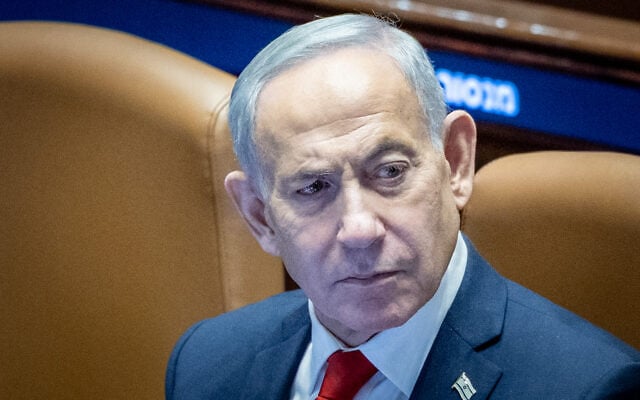
Prime Minister Benjamin Netanyahu attends a plenary session at the Knesset in Jerusalem, November 11, 2026. (Chaim Goldberg/Flash90)
Prime Minister Benjamin Netanyahu says he is willing to go second as premier in a rotation agreement with Gadi Eisenkot, as the Yashar chair makes strides toward forming a government without him.
Netanyahu presents his new position as a concession for the sake of the country’s welfare:
“In light of the magnitude of the existential danger and the possibility that a government without the ability to confront this danger will be formed, my responsibility as a leader requires me to put everything aside, including the principle of the largest party, and agree that Gadi Eisenkot will serve first as prime minister, and I will serve at the beginning of the term as alternate prime minister,” he says in a statement.
Netanyahu, whose coalition lost its majority in the October 27 election, asserts that “naturally” he ought to lead a unity government, or at least serve first in a rotation agreement, since Likud is the largest party, as had been his position until tonight.
“The Likud under my leadership is the largest party in the country, by a large margin of a quarter of a million more voters than Eisenkot’s party,” Netanyahu says. “Naturally, I should lead the unity government, or at least be first in a rotation.” (Likud won 27 seats in the election, with Yashar the second-largest party with 21 seats.)
However, President Isaac Herzog gave Eisenkot, not Netanyahu, a 28-day mandate on November 8 to form a government, since 67 of the 120 MKs recommended Eisenkot for prime minister, compared to 48 for Netanyahu, with the seven-strong United Torah Judaism not recommending any candidate.
In light of his new readiness to serve second as prime minister, Netanyahu says he expects Eisenkot’s bloc to immediately launch “open, genuine, honest and accelerated negotiations” in which it will show “similar readiness for compromise and concessions…to establish a national unity government that will repel the dangers and ensure Israel’s security and future.”
אזרחי ישראל,
לפני ימים אחדים, האמת והצדק יצאו לאור בבית המשפט. זה קרה בזכות רבים בעם ישראל שעמדו לצידי בעשור האחרון, ובראשם רעייתי שרה ובניי יאיר ואבנר – שעברו סבל קשה ותמכו בי בכל החזיתות.
בימים האחרונים, ראינו דבר נוסף: מראות מזעזעים בכנסת – עזיבת האולם בעת ההמנון, הפניית הגב…
— Benjamin Netanyahu – בנימין נתניהו (@netanyahu) November 28, 2026
As he has done over the past few weeks, Netanyahu paints the Arab-majority Joint List and Ra’am parties as terror supporters, seeking to forestall any coalition agreement between them and Eisenkot.
He recounts witnessing “shocking scenes in the Knesset,” including Arab lawmakers walking out of the hall during the national anthem, and lawmakers “turning their backs on wounded veterans, and slamming the door in the face of bereaved families.”
He says that “without firing a single bullet, hostile elements will take over the country from within.”
Netanyahu claims that the Arab parties — which he calls “supporters of terrorism” — “plan to grant Israeli citizenship to hundreds of thousands of Palestinians who will enter Israel from Judea, Samaria, Gaza and neighboring countries under the claim of family reunification.”
Then, he claims, they will establish Arab autonomous zones in the Negev and the Galilee, withdraw from the Israeli-controlled buffer zones in Gaza, Syria and Lebanon, and “bring the terrorists back to the doorsteps of our communities.”
“Ultimately,” he insists, they will “establish a Palestinian state under Iranian sponsorship on the ruins of Israel.”
“Some members of the terror-supporting parties speak soft words in Hebrew, while in Arabic they all express complete support for the terrorist organizations and for the destruction of Israel,” Netanyahu insists.
He makes the remarks two hours before Ra’am chair Mansour Abbas is expected to declare in an interview with Channel 12 that Hamas is a terrorist organization — one of Eisenkot’s demands for any party to join his government.
“This unity is the order of the hour,” says Netanyahu. “We have to confront immediate dangers that threaten our very existence.”
“The only way to do this is by combining all the parties that see Israel as the nation-state of the Jewish people,” a formula meant to include non-Zionist Haredi parties.
He promises to reach agreement with the ultra-Orthodox parties on army conscription, something he was unable to do in the previous government.
Key Update
‘Transparent con’: In apparent break from Bennett, Lapid rejects Netanyahu’s new offer to serve second as PM in a rotational government
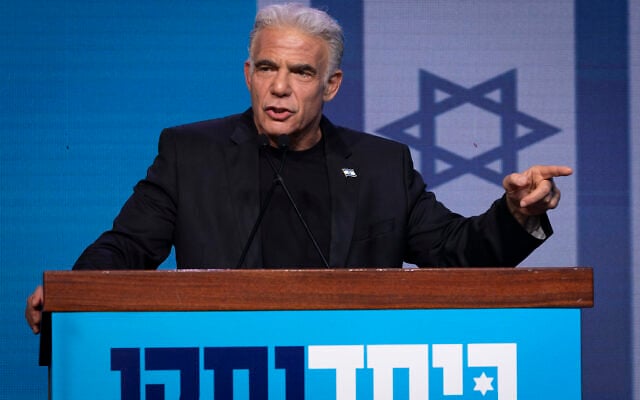
Israeli opposition leader Yair Lapid speaks at the B'Yachad party’s election headquarters in Tel Aviv on election night, October 28, 2026. (Noam Revkin Fenton/Flash90)
B’Yachad No. 2 Yair Lapid rejects what he says is a “transparent con” by Prime Minister Benjamin Netanyahu, after he announced he would allow Gadi Eisenkot to take the first turn in a rotation agreement for the prime minister’s office.
Netanyahu, Lapid warns on X, is a “serial deceiver who has cheated every partner and broken every agreement.”
He says the only way to assess whether Netanyahu’s offer is a genuine one is to swear in a government led by Eisenkot without Likud, and then begin negotiations on its inclusion at a later date.
Lapid’s comments contradict the position taken by B’Yachad chair Naftali Bennett, who has been pushing Eisenkot’s Yashar to form a unity government with Likud, believing it preferable to a coalition reliant on the ultra-Orthodox and Arab parties.
There is no immediate comment from Bennett on Netanyahu’s new offer.
Democrats chair Yair Golan writes on X: “Enough with the tricks and shticks. Netanyahu has lost. It is our duty to respect the will of the voters and form a government of change and rescue.”
Key Update
Likud lawmakers rush to back Netanyahu’s rotation offer, saying Eisenkot bloc must choose between love of Israel or hatred of PM
As expected, Likud ministers and lawmakers rush to offer their support for interim Prime Minister Benjamin Netanyahu’s announcement that he is willing to go second in a rotation agreement with Gadi Eisenkot.
Energy Minister Eli Cohen says that Netanyahu has proven that Israel’s welfare is his top priority. “If Israel is more important to Eisenkot than his hatred for Netanyahu,” says Cohen, “he must stop his rush toward a government that relies on enemies of Israel, and form a unity government that will be able to stand up to the many challenges facing us!”
The enemies of Israel that Cohen is referring to are the Arab-led Joint List and Ra’am parties.
Sports and Culture Minister Miki Zohar says that even though it is tough to accept Eisenkot going first as prime minister, Netanyahu is showing “extraordinary leadership.”
The reactions seem tightly coordinated, offering nearly identical messages and all released at the same time.
Education Minister Yoav Kisch calls it “a moment of truth” for the Eisenkot bloc: “Does their love of Israel overcome their hatred of Netanyahu?”
“The left is at a crossroads,” echoes Likud MK David Peter. “On one side, Zionist unity, and on the other, the realization of the dream of [Muslim Brotherhood figures] Hassan al-Banna and Yusuf al-Qaradawi on the ruins of Israel.”
Report: Bennett told Netanyahu to offer Eisenkot top job by Sunday or he would abandon push for unity government
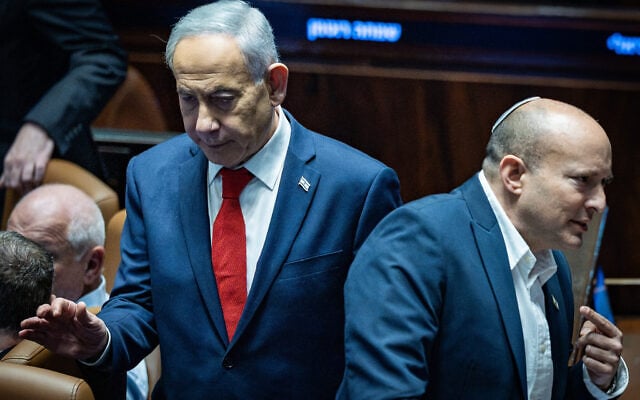
Prime Minister Benjamin Netanyahu walks past B'Yachad chair Naftali Bennett during a plenum session at the Knesset in Jerusalem, November 18, 2026. (Yonatan Sindel/Flash90)
Prime Minister Benjamin Netanyahu’s offer to serve second in a rotation deal for prime minister, with Gadi Eisenkot taking the first turn, is the result of pressure from B’Yachad chair Naftali Bennett, Channel 12 reports.
According to the report, Bennett informed Netanyahu that if he didn’t offer Eisenkot the option of serving as the first prime minister in a rotational unity government by Sunday, B’Yachad would abandon its push for unity and sign a coalition agreement with Yashar.
The other parties in the so-called change bloc have already signed agreements with Eisenkot.
Bennett’s ultimatum also reportedly contributed to his decision to cancel a meeting with Eisenkot on Thursday, pushing it off until Sunday.
‘Respect him but suspect him’: Bennett cautiously welcomes Netanyahu’s offer for rotation deal with Eisenkot
B’Yachad chair Naftali Bennett welcomes Prime Minister Benjamin Netanyahu’s announcement that he will agree to serve second in a rotation agreement for prime minister, allowing Gadi Eisenkot to go first, but says the offer should continue to be treated with suspicion until it is proven genuine.
“Netanyahu made the right decision when he announced he was willing to form a unity government, initially led by Eisenkot, based on an ‘alliance of those who serve,'” Bennett writes, referring to his desire for a coalition made up only of Zionist parties that support military service, meaning all but the Haredi or Arab parties.
“The burden of proof now lies with Netanyahu to show that this is genuine intent and not lip service,” Bennett continues, warning the Likud leader against “stalling tactics or futile discussions aimed at sabotaging the formation of a government that excludes him.”
“We shall proceed according to the principle: Respect him, but suspect him — and then suspect him again.”
He reiterates his demands for a unity government: creating prime ministerial term limits; forging new agreements on reforming the judicial system while throwing out the last government’s judicial overhaul legislation; advancing new laws for the well-being of IDF soldiers and reservists; and addressing the manpower needs of the IDF.
Ultra-Orthodox UTJ split by Netanyahu’s latest offer for unity government with Eisenkot
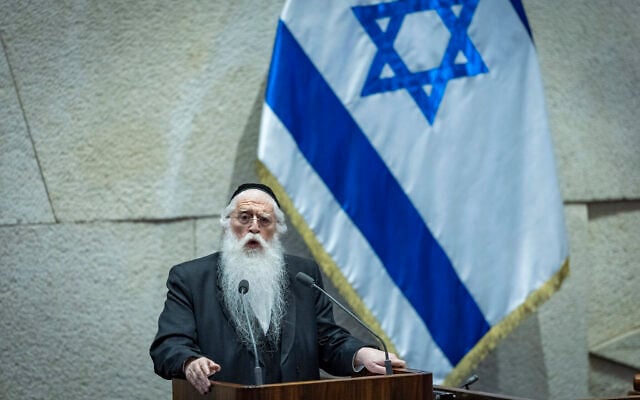
UTJ MK Meir Porush attends a plenary session at the Knesset in Jerusalem, a day after the swearing-in of the 26th Knesset, November 11, 2026. (Chaim Goldberg/Flash90)
As the ultra-Orthodox United Torah Judaism party prepares for official coalition talks with Gadi Eisenkot’s Yashar, UTJ MK Meir Porush says he would prefer a unity government with Likud to one solely headed by Eisenkot.
Porush is considered one of the most staunchly pro-Netanyahu voices in UTJ, even as the party has distanced itself from its once-firm ally over Haredi military conscription.
“This is doubtless the preferred option at this time, given the dangers threatening the people of Israel,” Porush says of Netanyahu’s offer for a rotation agreement with Eisenkot, which would see the Yashar leader take the first turn in the prime minister’s office.
He calls for Eisenkot to pursue unity with Netanyahu, and says he is confident “even the most sensitive and important issues to the ultra-Orthodox public can be resolved” through genuine negotiations.
Contradicting Porush, Ynet reports that an anonymous senior UTJ official has dismissed Netanyahu’s offer out of hand.
“While Bibi and the right-wing lecture the ultra-Orthodox, telling us not to align ourselves with Eisenkot, Bennett and Lapid, Bibi himself is willing to take the second spot in a rotation deal, to kick out [ultranationalist Otzma Yehudit chair] Ben Gvir and the Haredim, just so that these ‘leftists’ form a government with him and keep Likud in power,” the official is quoted as saying.
The official accuses Netanyahu of “actively working against the very people who have stood by him all these years.”
Three Israelis, including 2 off-duty soldiers, arrested for entering Palestinian village, firing on residents
Three Israelis, including two off-duty soldiers, were arrested by the police for entering a Palestinian village in the southern West Bank earlier today and opening fire on residents, injuring one man.
Footage showed three Jewish Israelis, two of whom were armed, entering at-Tuwani in an apparent attempt to taunt Palestinian residents.
At one point, the armed Israelis opened fire, hitting a Palestinian man in the shoulder who was evacuated for medical care.
The Honenu legal group representing the suspects says that the Israelis were attacked by Palestinians throwing stones, and in response they opened fire. However, no explanation is given as to why the group entered a Palestinian village to begin with.
Police say officers and Shin Bet members were dispatched to the scene to collect evidence and detain the trio.
They are identified by police as two soldiers in their mandatory service who live in the area, along with a resident of Tel Aviv in his 20s.
Due to the involvement of the soldiers, police say they are handing over the case to the Military Police.
אירוע נוסף שקורה במהלך השבת בא-תוואני בדרום הר חברון:
3 יהודים, 2 מהם חמושים בנשקים ארוכים – נכנסים לתוך הכפר הפלסטיני.
בזמן שהפלסטינים יוצאים לקראתם ומנסים להבריח אותם מהכפר (לא ניתן לראות מה קורה בצידו השני של התיעוד, הפלסטינים עצמם לא מתועדים, אבל בהחלט היה ניסיון תקיפה… pic.twitter.com/9Oe8YGJVEK— דורון קדוש | Doron Kadosh (@Doron_Kadosh) November 28, 2026
UK, France, six other countries call on Abbas to hold postponed PA elections in early 2027
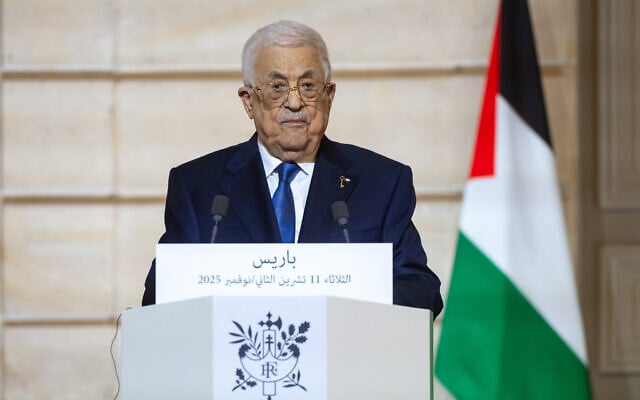
Palestinian Authority President Mahmoud Abbas attends a joint statement with French President Emmanuel Macron (not in picture) at the Elysee Palace in Paris, France, November 11, 2025. (Christophe Petit Tesson, Pool via AP)
Eight Western countries — including the UK, France and Australia — call on the Palestinian Authority to hold the legislative and presidential elections that PA President Mahmoud Abbas postponed.
The call from the foreign ministers of Australia, Belgium, Canada, France, Luxembourg, Norway, Poland and the United Kingdom comes on the originally scheduled date of the PA legislative elections. In October, Abbas said they would be pushed off until September of next year.
“On this day when Palestinians should have been exercising their democratic right to vote, we once again express our deep regret over the decision taken by President Abbas to postpone the Palestinian legislative elections,” say the foreign ministers.
“Twenty years after the last national election in Palestine, and five years after the postponement of the legislative elections planned for 2021,” they continue, “this lack of elections continues to deprive the Palestinian people of the right to express themselves democratically through the ballot box and to choose their representatives in free and transparent elections, as President Abbas had pledged.”
They say elections are crucial to the Palestinian Authority returning to Gaza and to the two-state solution.
They call on the PA to hold elections in the first three months of 2027, and call on “all parties” — which includes Israel — “to facilitate the holding of these elections throughout the occupied Palestinian territory.
In a subtle threat, the countries say that their “continued support for the Palestinian Authority and our commitment to strengthening its institutions go hand in hand with the respect for the commitments made regarding reforms and democratic renewal.”
Eisenkot invites Netanyahu to talks tonight, says he has 24 hours to prove his rotation offer is genuine
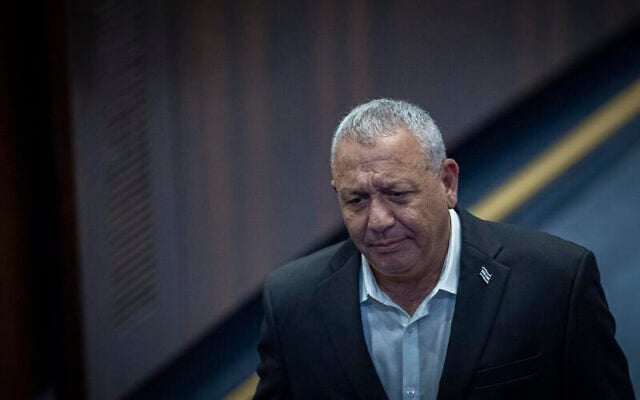
MK Gadi Eisenkot during a plenary session at the Knesset in Jerusalem, November 25, 2026. (Chaim Goldberg/Flash90)
Yashar leader Gadi Eisenkot responds to Prime Minister Benjamin Netanyahu’s offer to serve second in a rotation agreement, with Eisenkot going first, by inviting the Likud leader and his team to meet with him tonight at the Dan Accadia Hotel in Herzliya for immediate negotiations.
He notes, however, that Likud has rebuffed efforts to negotiate for nearly three weeks and has yet to respond to a detailed proposal sent on Sunday.
“If Likud is ready for genuine unity, I am prepared to assess its seriousness over the next 24 hours,” Eisenkot says, inviting Netanyahu and his team to join him tonight “for genuine, accelerated talks on guiding principles and policy issues,” based on the proposal to which Netanyahu has yet to respond.
“The unity Israel needs — which I am ready to pursue and for which I am prepared to pay a political price — is unity among Israeli citizens based on shared values,” he continues.
Eisenkot says the proposal, sent through “a secret channel, established at [Netanyahu’s] request,” addressed “substantive issues.” He says his side offered “significant compromises” on some of them before proceeding with coalition agreements with Yisrael Beytenu and the Democrats.
“For nearly three weeks, my team and I have been proposing and trying to conduct genuine, good-faith and accelerated negotiations, but we have encountered refusals and evasions,” he adds.
Reports: Likud claims Netanyahu phoned Eisenkot before his announcement but didn’t receive answer
Prime Minister Benjamin Netanyahu’s Likud claims the premier tried to phone Yashar’s Gadi Eisenkot before announcing he was prepared to go second in a rotation deal for prime minister, but Eisenkot did not return the call, Hebrew-language media reports.
The party says Netanyahu also phoned Eisenkot following the announcement, but the Yashar chair still has yet to answer.
Likud says that Netanyahu is prepared to begin talks, but that he is waiting for Eisenkot to respond to him.
Eisenkot said in a public statement that his team was ready to immediately begin talks at the Dan Accadia Hotel in Herzliya.
Security cabinet to convene tomorrow to advance Trump’s plan for Gaza after months of delays — report
Prime Minister Benjamin Netanyahu will convene the security cabinet tomorrow evening to discuss a series of steps aimed at implementing US President Donald Trump’s 20-point plan for Gaza, Hebrew media reports.
Earlier, The Times of Israel reported that Board of Peace senior envoy Nickolay Mladenov warned Netanyahu this week that the US-controlled panel will be forced to hand back its mandate for overseeing the postwar recovery of Gaza if the premier doesn’t start making good on his commitments under the ceasefire agreement inked last year.
The security cabinet is expected to approve the deployment of the Board of Peace-backed International Stabilization Force in the Gaza Strip, Ynet reports, and grant permission for 4,000 Palestinians to receive police training in Egypt, once they have been vetted by the Shin Bet.
The cabinet will also reportedly approve the entry of equipment and materials for humanitarian and infrastructure projects in the war-torn Strip.
Key Update
Eisenkot will meet with Netanyahu tomorrow morning on possible unity government, has updated ‘change bloc’ leaders
Prime Minister Benjamin Netanyahu and Yashar chair Gadi Eisenkot will meet tomorrow morning to discuss a potential unity government, after Netanyahu tonight said Eisenkot could serve first as prime minister in such a government.
Netanyahu’s Likud confirms the meeting will be held at 10 a.m. at the Dan Acadia hotel in Herzliya.
In the meantime, Yashar says Eisenkot spoke with the leaders of the other so-called change bloc parties — Yisrael Beytenu, B’Yachad and The Democrats — this evening and brought them up to date on recent developments.
In an unsourced report, Channel 13 News says that prior to Netanyahu’s statement, Eisenkot was preparing to announce tonight that he had assembled a coalition.
Key Update
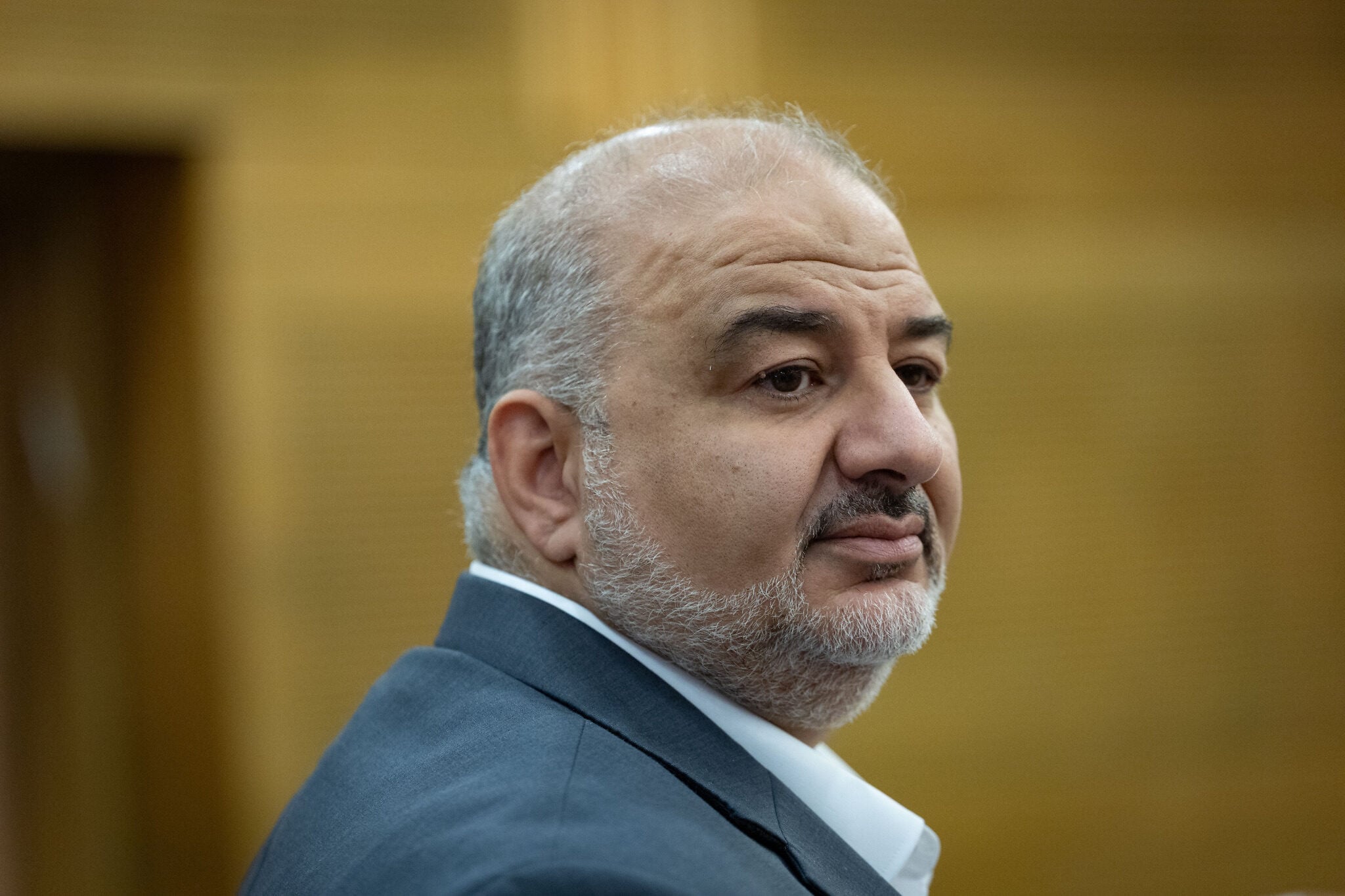
Mansour Abbas affirms that his Ra’am party considers Hamas a terror organization; avoids explicit declaration
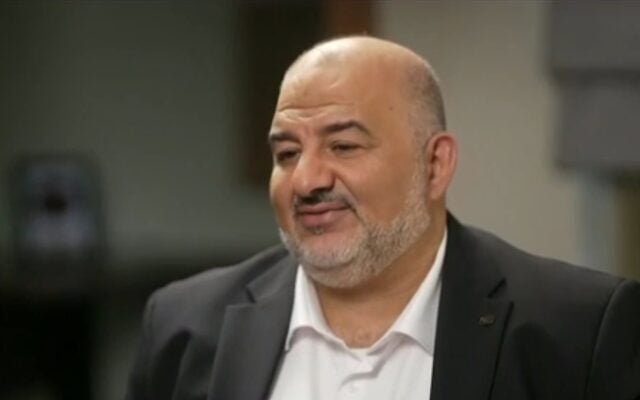
Ra’am chairman Mansour Abbas during an interview on Channel 12, broadcast on November 28, 2026. (Screen capture: Channel 12)
Ra’am party chief Mansour Abbas affirms that he and his Ra’am party consider Hamas a terror organization, in an interview with Channel 12 news.
Abbas avoids making an explicit declaration, but confirms that his party co-sponsored a bill advanced in the Knesset this week that describes Hamas as a terror organization, and that he himself voted for it.
Abbas is asked by interviewer Dana Weiss to read from the text of the bill, which calls for the establishment of a state commission of inquiry into the Hamas-led October 7, 2023 invasion. He reads: “… the Hamas organization, together with additional terror organizations, in a large-scale terror attack from the Gaza Strip against the State of Israel…”
“Now, you’re a signatory to this bill, correct?” Weiss asks him.
“Yes,” responds Abbas.
Weiss says, “And what does it say here?”
Abbas replies: “The terror organizations, chief among them Hamas.”
“The only way to understand this, that a bill that you signed… has written in it, in black-and-white…” Weiss says as she waits for him to complete the sentence.
“…You define Hamas as a terror group,” Abbas answers.
“So we’ve closed this issue?” she asks.
“This issue has been closed for me for some time,” says Abbas.
Later in the interview, Weiss and Abbas return to the issue.
Abbas: “You have the bill, don’t you?”
Weiss: “Yes.”
Abbas: “What’s written is what’s written.”
Weiss: “Which is?”
Abbas: “That Hamas is a terror organization. Don’t you see it written there? That’s it — the matter is closed.”
He says his wavering about whether to “say or not to say it” did not have to do with Hamas’s actions.
“Our hesitation over whether or not to say it was never about their actions, their standing, or their conduct. We condemned and defined those actions as terror actions, full stop, and so on. But there are people who use this as a political instrument, and so they pushed us into a corner on it. Beyond that, we also want to make sure the thing isn’t used to declare total war on every Palestinian baby, every Palestinian woman, on the entire Palestinian people,” he says.
He further elaborates that someone “defined all the residents of the Gaza Strip as Hamas, as a terror organization, meaning that he would either eliminate them all, or expel them all, or throw them into the sea. And so if I’m careful in how I express myself, it’s because I don’t want it to look as though I’m granting approval or support [for that person to] do whatever you please.”
Gadi Eisenkot has issued four conditions for potential coalition partners in any government he heads, and Abbas’s comments in the interview appear to satisfy them. He confirms in the interview that he recognizes Israel as a Jewish and democratic state, accepts the values of the Declaration of Independence, backs mandatory national service for all citizens, and recognizes Hamas as a terror organization. That final condition also speaks of a commitment to dismantling Hamas’s military capabilities and governance, a subclause that Abbas does not specifically confirm.
Key Update
Mansour Abbas: I decided to share Netanyahu’s ‘understanding’ with Sinwar after being attacked by PM as terror supporter
Ra’am chair Mansour Abbas shares that the premier’s speech at the swearing-in of the Knesset — in which he accused Arab parties of supporting terrorism — prompted him to publicize how Prime Minister Benjamin Netanyahu told him about an implicit understanding he had with Hamas leader Yahya Sinwar in 2021.
In an interview with Channel 12, Abbas says he thought about the “massive gap between the man who is attacking us, inciting against us, accusing us of being terror supporters…[and] the conversation I had with him at [the Prime Minister’s Residence] at Balfour Street, during Operation Guardian of the Walls, in which he told me about his relationship with Sinwar — that they both understand one another.”
Shortly after Netanyahu’s angry speech earlier this month, in which he denounced the Knesset’s two Arab-led parties as unsuitable partners for a government and accused their members of seeking Israel’s destruction and supporting terrorism, Abbas revealed the conversation for the first time.
He says he intended to save the conversation for a commission of inquiry into October 7, but decided to publicize it after being attacked at an event that was supposed to be a non-political celebration.
UTJ chair says party supports unity but is prioritizing Haredi conscription law above all else
United Torah Judaism chair Ya’akov Asher says his party supports unity, viewing it as “essential for the Jewish people,” but reiterates that its priority is, above all else, the matter of military conscription for ultra-Orthodox men.
“The question for us is not the formation of the next government, but rather regulating the status of yeshiva students and Torah scholars,” he says. “We made this clear in our discussions with both sides.”
“The coming days will reveal whether the recent developments can lead to a resolution of this issue,” he adds.
Protesters demonstrate in front of Bennett’s home against unity government with Likud
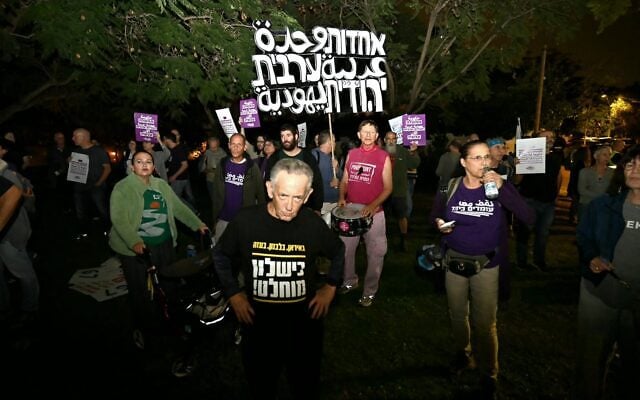
Protesters demonstrate outside the Ra'anana home of B'Yachad chair Naftali Bennett in opposition to his push for a unity government with Likud, on November 28, 2026. (Danor Aharon/Pro-Democracy Protest Movement)
Protesters demonstrated outside B’Yachad chair Naftali Bennett’s home in Ra’anana earlier this evening in opposition to his push for a unity government with Prime Minister Benjamin Netanyahu.
The protest took place as Netanyahu announced that he would be willing to allow Yashar chair Gadi Eisenkot to take the first turn as prime minister in a rotational unity government — something that Bennett has been pushing for despite opposition from some of his allies in the so-called change bloc.
Some protesters hold signs demanding: “A Jewish-Arab government now,” or featuring the phrase, “A government for everyone,” written in Hebrew, Arabic, Russian, Amharic and Yiddish.
A billboard mounted on a nearby van warned Bennett: “Don’t sell us out.”
A simultaneous protest calling for unity with Likud was staged near the Knesset in Jerusalem.
Houthis claim they attacked Saudi airport, oil refinery, and power stations in past 48 hours
Yemen’s Houthis said on Saturday they attacked Riyadh’s King Khalid International Airport, the Jazan oil refinery and two power stations in southern Saudi Arabia over the past 48 hours.
The latest claims mark a further escalation in the Houthis’ attacks on Saudi infrastructure, particularly energy facilities, amid renewed hostilities between the Iran-aligned group and Saudi Arabia.
Ra’am chair Abbas: My life is at risk after signing bill calling Hamas terror group
Ra’am party chief Mansour Abbas says his family could be threatened after his party signed a bill that refers to Hamas as a terror group.
In an interview, Channel 12’s Dana Weiss asks, “Did you put your family at risk?”
“Could be,” he responds.
He says his life is “certainly” under greater threat.
“Someone will think, ‘he’s our enemy, let’s go eliminate him,'” says Abbas.
Abbas says that some Arab-Israelis have been telling him not to call Hamas a terrorist organization, while others have been urging him to do so in order to “close this chapter already.”
He says his party “will try to deal with” the consequences of the bill and will “try to explain to people.”
Key Update
Palestinian man killed, IDF officer moderately hurt in West Bank altercation
An IDF combat officer was moderately wounded after being mistakenly shot by his comrade during an altercation with a Palestinian suspect in the West Bank this evening, the military says.
The Palestinian man, identified by the Palestinian Authority’s health ministry as Hikmat Mohammed Faraj, 57, was killed in the incident.
According to the IDF, troops raided a building in the village of Madama, near Nablus, from which stones had been hurled at the forces.
Inside the home, a “physical confrontation” erupted, during which the army says a “terrorist attempted to snatch the weapon of a combat officer.”
“The officer fired at him, but the terrorist deflected the weapon during the shooting, as a result of which another combat officer who was nearby was moderately wounded,” the military says.
The IDF says the suspect continued to struggle with the troops, and he was eventually “neutralized.” According to the PA health ministry, the man succumbed to his wounds after being shot.
The wounded officer was taken to a hospital for treatment, and his family was notified, the army adds.
Ra’am’s Abbas: We don’t want to run Israel’s foreign policy; we are operating as part of the would-be coalition bloc
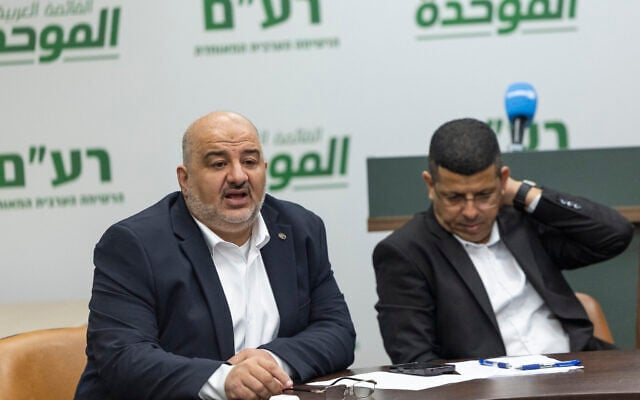
Ra’am party head MK Mansour Abbas (L) leads a faction meeting, at the Knesset in Jerusalem, on November 23, 2026. (Chaim Goldberg/Flash90)
The Ra’am party is “operating as part of the bloc that is supposed to be in the coalition,” says faction chief Mansour Abbas.
Abbas stresses in a Channel 12 interview that his party is “not going into a government to decide and manage Israel’s security and foreign policy,” amid accusations that a coalition that depends on Arab parties won’t be able to go to war against Israel’s enemies.
“We want to protect people’s personal safety in general, and specifically that of Arabs,” Abbas stresses.
The goal of negotiations with Gadi Eisenkot is not only to replace Benjamin Netanyahu, but also “to create a government that will last 4 years, and to work,” says Abbas.
He says his party is “in a state of readiness; we want to see that the building of the coalition is moving forward, step by step, agreement after agreement.”
Mansour Abbas: I could be assassinated for supporting Eisenkot bloc
Ra’am’s Mansour Abbas says that he “has made peace” with the idea that he could be assassinated — presumably by someone on the right — for supporting the coalition Gadi Eisenkot is forming.
Speaking to Channel 12, Abbas warns that all members of the emerging government could be targeted, “from the prime minister on down.”
The way to stop such an outcome, he says, is “determined leadership, to return the authorities to the statesmanlike path.”
Abbas warns if the Arab parties don’t operate differently in an environment of incitement from political figures against Arabs, there would be a repeat of the intercommunal violence that wracked mixed Jewish-Arab cities in 2021.
Abbas also criticizes the decision of the Arab-majority Joint List party to walk out during the singing of Israel’s national anthem during the swearing-in of the Knesset on November 10.
All the MKs from Abbas’s party except him and his deputy, MK Yoav Segalovitz — the party’s only Jewish lawmaker — walked out too.
The event, Abbas says, “was supposed to be an expression of a different approach to political behavior by all the Arab parties, not only Ra’am.”
He stresses that in the past, Joint List faction chiefs would remain in the hall without singing. “Stand and give respect to this state occasion,” he says.


read more: