

 From the Liveblog of
Sunday, June 8, 2025
From the Liveblog of
Sunday, June 8, 2025
Think tank: IAEA found Iran conducted, covered up implosion tests key to building nuclear weapon in 2003
 Add ToI as a Preferred Source on Google
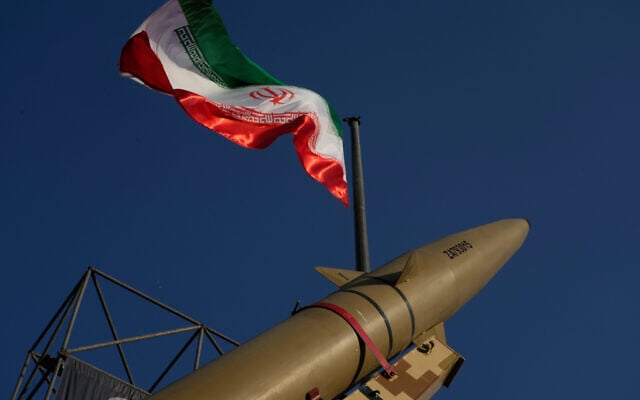
Iran conducted and covered up “a number” of implosion tests that are key to developing a nuclear weapon in 2003, an analysis of the International Atomic Energy Agency’s May 31 report on the Islamic Republic’s nuclear program reveals.
According to the Washington, DC-based Institute for Science and International Security think tank, which analysed and published key points from the IAEA report, the activities carried out by Iran were in preparation for a “cold test” in the development of a nuclear bomb, which involves the creation of “a fully assembled nuclear device with a surrogate core of natural or depleted uranium rather than weapons-grade uranium.”
Four tests were carried out in Marivan that “utilized ‘full-scale hemispherical implosion systems,’ involving the initiation of high explosives, with the generation of a spherically inward shock wave, and a resulting compression of a nuclear explosive core, minus the weapons-grade uranium and EDNS,” according to the institute, citing the IAEA report.
Explosively driven neutron sources are devices that utilize high explosives to create a burst of neutrons, and are key for the building of nuclear weapons.
According to ISIS, the IAEA’s report reveals for the first time that activities at the four nuclear sites — Marivan, Lavisan-Shian, Varamin, and Turquz-Abad — are deeply connected with the issue of missing nuclear material.
Iran, which is sworn to Israel’s destruction, has denied seeking to build a nuclear weapon while enriching uranium to levels that have no use for civilian purposes.







The Times of Israel Community.